

Practice Areas

Financial Services
South Africa’s financial services sector is sophisticated and well developed and supported by a sound regulatory and legal framework. The country’s five biggest banks continue to dominate the sector, despite an increase in competition. These banks face competition from smaller players, including Capitec, African Bank, and more recently Discovery Bank, and TymeBank.
South Africa, the largest and most established insurance market, accounts for 70 percent of total premiums.
The South African banker and financial executive needs to have a good understanding of the country’s macroeconomic and socio-political conditions. They need to have well established local business and political networks to conduct business successfully.
Consumer Goods Industry
South Africa, the continent’s most sophisticated economy is already the biggest retail market in sub-Saharan Africa, with a sizable food and non-food manufacturing sector. Total retail sales continue to expand steadily driven by the continued emergence of a black middle class.
The increased emphasis on omnichannel retailing, evolving consumer behaviour, and disruptions in supply chain creates bottlenecks have forced these leaders to quickly adapt and innovate to remain competitive.
South Africa, the largest and most established insurance market, accounts for 70 percent of total premiums.
The South African banker and financial executive needs to have a good understanding of the country’s macroeconomic and socio-political conditions. They need to have well established local business and political networks to conduct business successfully.


Transport and Logistics
South Africa has a sophisticated transport and logistics industry. South Africa still ranks above all other African countries by a substantial margin where transport infrastructure is concerned.
The modern transport and logistics leader require skills in operational execution, driving growth, influence and networking and international business exposure.
Healthcare
South Africa runs a two-tiered healthcare system made up of the public and private sectors. Currently, the public sector provides health care for 80% of the population and accounts for approximately 48% of total health care spending. The private sector provides health care for 20% of the population and accounts for approximately 50% of total health care spending while the remaining 2% is provided by non-governmental organisations. South Africa has a well-developed pharmaceutical market, private hospital network operators and the sector has about 78 medical schemes in South Africa with approximately 8.88 million members.
Today’s healthcare executive requires the ability to not only offer world class healthcare services, but also use data and technology to pioneer new models of healthcare and be responsive to the patients needs.


Technology, Media and Telecommunications
The sector will continue to realise growth in revenue and earnings as rising investment in networks deliver growth in South Africa and international markets. Convergence between technology providers and content organizations is blurring traditional industry lines, creating new revenue opportunities and new competitors.
The leader in the sector must build strong brands, create compelling customer experiences, generate new revenue streams, and manage risks.
Industrial Sector
The industrial manufacturing sector is large and diverse, but most sector players face similar challenges. The past few decades have been difficult, with external and domestic factors weighing on the sector. Increased costs for oil, natural gas, steel, and copper are squeezing margins. The single biggest segment of the manufacturing sector is food and beverage, followed by petroleum, chemical products, rubber and plastic products, basic iron and steel, metal products, wood, motor vehicles, textiles.
The industrial executives of today must be able to aggressively pursue export markets, manage risks, build close-knit supply chains and manufacturing zones, and become more innovative in products, manufacturing processes, and materials.


Public Sector, Education and Not for Profit
The government is a significant sector of the economy and has continued to register growth in employment. State Owned Companies have huge capital infrastructure programmes that have resulted in job creation and growth.
Business leaders need to interact with politicians to conduct business successfully. They need to have a good understanding of the local macroeconomic and socio-political conditions and have well established network of stakeholders.
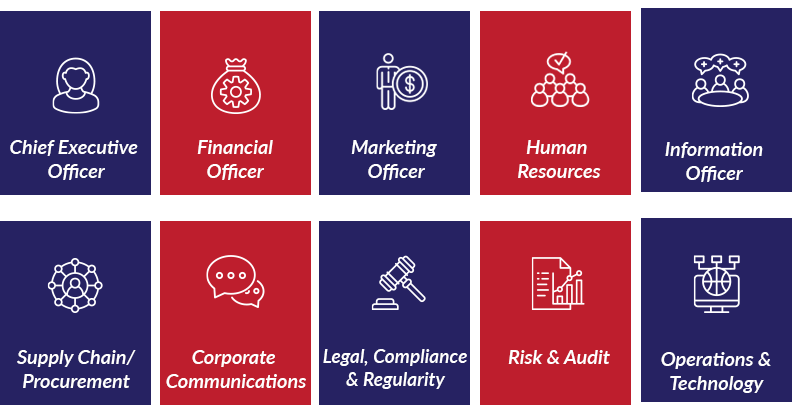
Functions
Contact
Phone
Address
The Business Exchange,